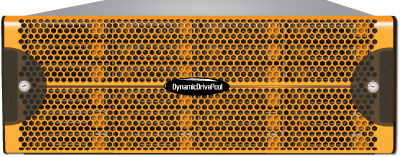
So for this company the DDP with its drivers was connected to Windows and Mac workstations which solely having been using Nexis until now.
Despite edit solutions such as Black Magic Resolve and Premiere, after all these years Media Composer is still the most favored edit application.
Also with this customer.
The customer has been using Media Composer with their current Avid Nexis shared storage for more then 5 years now.
So it was time to renew the storage.
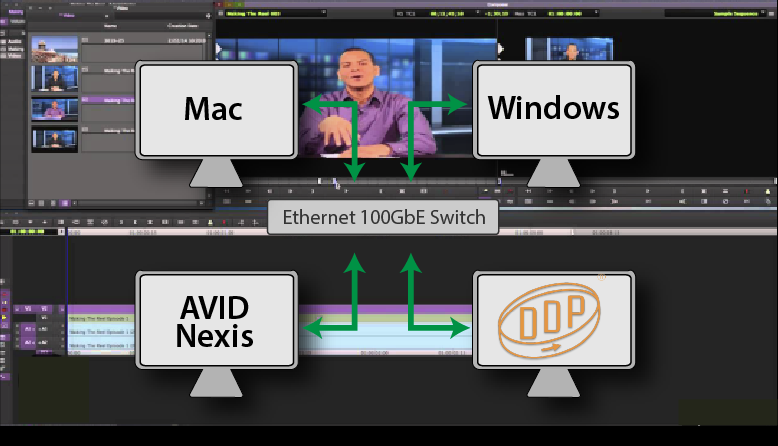
They decided to checkout first if the DDP with its Project Caching would be a good alternative and eventually transition to the DDP entirely. To test this it was essential that the DDP with native bin locking and project sharing could be used alongside the Nexis. So the DDP with its drivers was connected to Windows and Mac workstations which solely having been using Nexis until now.
It showed that for operators it does not matter from which system bins, project and media were accessed. For any company using Media Composer this is important knowledge.
For an investment plan one has to determine bandwidth and capacity required, whether it should be SSDs or hard disks or a mixture of both, network adapters and support prices.As a unique feature the DDP can be delivered with Project Caching giving SSD performance with hard disk capacity at an affordable price.
Of course there are other differences between DDP and Nexis notable. Bandwidth of a DDP starts at 1GB/s with SSDs for Project Caching. The remaining empty slots can be filled with hard disks from 4 to 24TB.
Also while Nexis uses workspaces DDP users folder volumes. These folder volumes are folders with volume properties underneath the file system. Like workspaces each folder volume can hold an Avid Mediafiles directory. Unlike workspaces though when a folder volume needs more capacitiy its quota setting can be increased. Also when files are deleted the released capacity automatically becomes available for all.