

A Case For
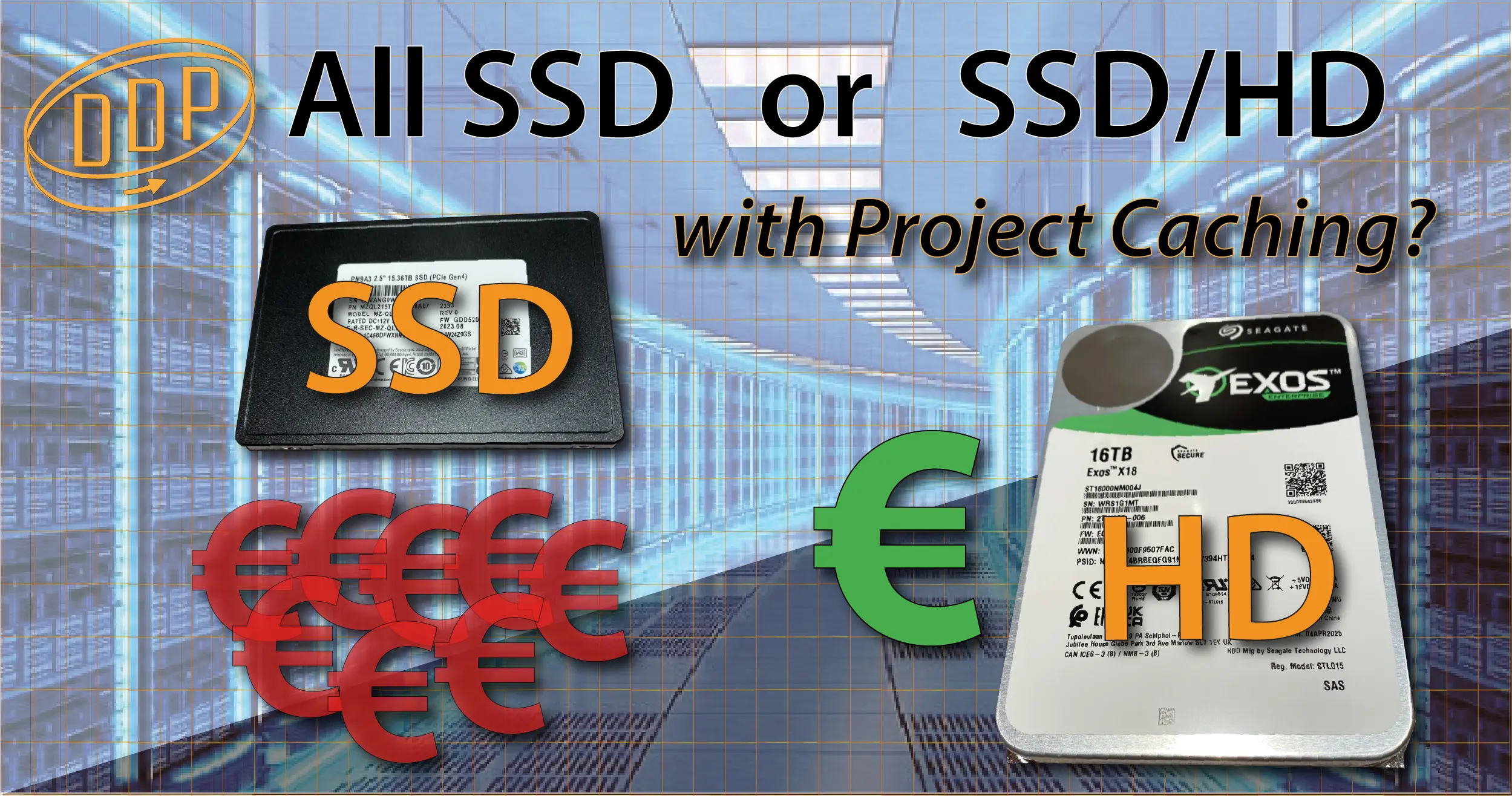
The growing number of AI data centers have a large impact on the availability of hard disks, solid state disks and memory. When demand far exceeds deliverability prices increase. This is exactly what happens at the moment with hard disks, SSDs, memory and CPUs.
So we had to adapt our prices as well.
However, one can mitigate this increase by seeking a perfect balance between the size of the Project Cache and the hard disk capacity.
We think everyone can agree that the best shared storage solution is an all SSD solution.
A big advantage of SSDs is that bandwidth specified is valid no matter if it is audio and or any video or film format. This is because SSDs are like memory and have no seek time. However SSDs are many times more expensive then hard disks.
But we have good news and that is Project Caching. You can choose the SSD size for Project Caching and hard disk capacity independently in a DDP. This way you can remain as close as possible to a planned budget. Keep in mind that this type of cache is also used most efficiently. Only project files needed are in the cache.
For each project a (sub)folder structure is created. Selection of a cache method per (sub)folder can be manually or automated. Material can be ingested in the cache and copied through to the hard disks or the other way around. The Project Cache bandwidth can be from 1GB/s to 40GB/s and beyond depending on type and quantity of the SSDs.
A good system to look at for example could be a DDP24D. The 24 carriers can be filled with SSD and HD packs of different sizes.
So lets fill it with an SSD8 pack of 1TB SSDs and two HD8 packs of 12TB hard disks. This gives a 7TB raid protected Project Cache and 144TB of raid protected hard disk capacity.
With the A/V FS file system within the DDP the cache and hard disks behave as one integrated system. Each file within A/V FS can exists in the cache and on hard disks simultaneously.
A more detailed explanation of the Project Caching features can found on the www.ddpsan.com home page.
So estimate how much cache you need look at the size of the projects which are worked on today. It is not a critical decision because files not in the cache are automatically taken from the hard disks.
As an example the 7TB Project Cache can hold around 15 hours of DNxHR HQ video material at around 100MB/s. With a format such as ProRes HQ around 50 hours of material can be cached with the configuration we picked. Questions? Just ask us!
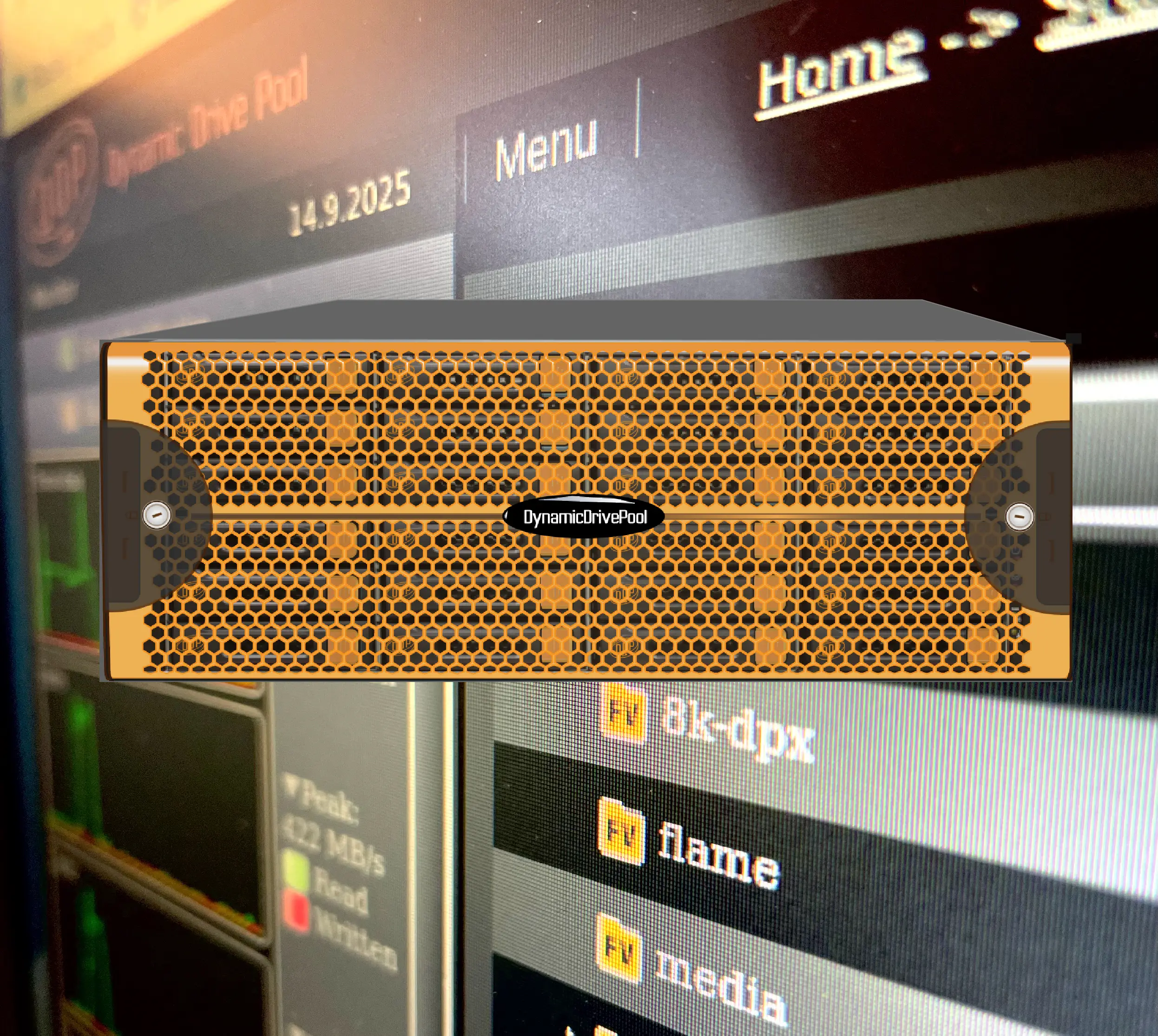
On the webpage www.ddpsan.com/products and then DDP24D you’ll find all technical details
about working with this DDP within your company
Go to the DDP24D page or Go to All User Cases